Bullet heaven vs bullet hell: what you actually control
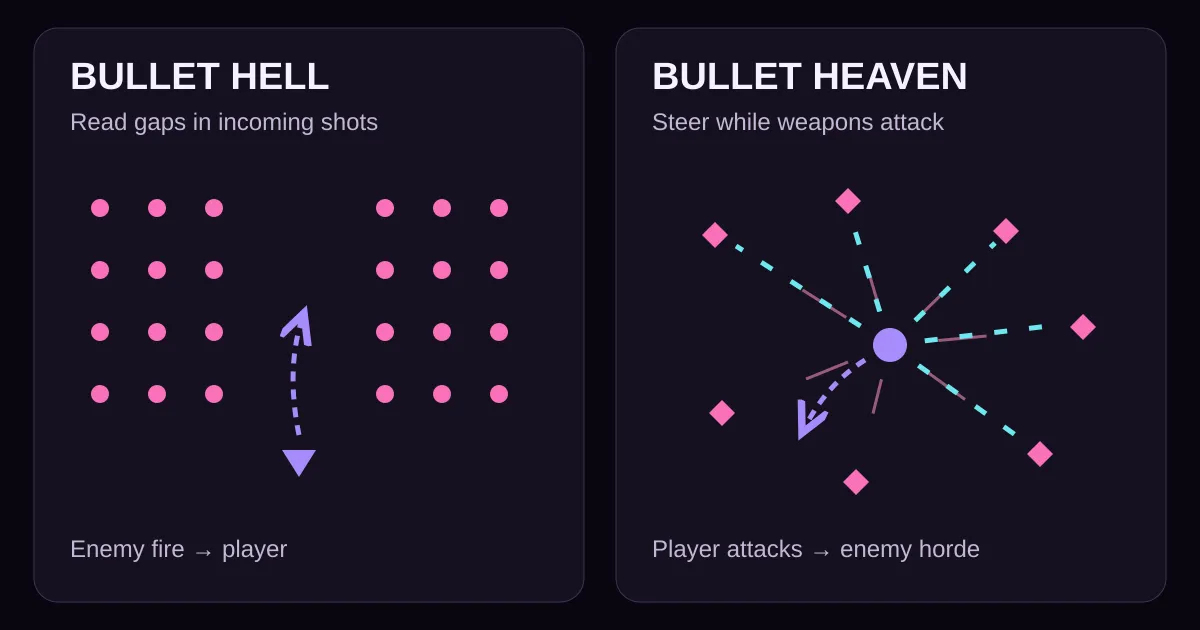
Bullet heaven vs bullet hell comes down to the main survival challenge: bullet hell asks you to dodge dense enemy shot patterns, while bullet heaven usually asks you to move through hordes as your weapons attack automatically and you choose upgrades. Both can demand careful movement. Automatic attacks don't mean automatic survival, and neither label tells you whether a game supports co-op.
Bullet heaven vs bullet hell at a glance
A bullet hell game makes navigating hostile projectile patterns a central challenge. A bullet heaven game usually combines horde survival, automated attacks and a growing character build; you'll also see the terms “reverse bullet hell” and “survivors-like.”
| Bullet hell | Bullet heaven |
|---|---|
| Dodge patterns | Manage hordes |
| Read gaps | Plan routes |
| Timing focus | Build focus |
Choose bullet hell for repeated pattern-reading challenges. Choose bullet heaven for building a survivor while managing a crowd. Attacking still matters in bullet hell; bullet heaven attacks are often automatic, but aiming or active powers may still be available.
These are useful descriptions, not rules that every game follows. A horde-survival game can also have bosses that fire patterns you must dodge.
What does bullet hell ask you to do?
Bullet hell asks you to find safe space between enemy shots while continuing to fight. The important question is where the projectiles are moving, not just how many are visible.
CAVE's Mushihimesama store page gives a concrete example: it describes elaborate shot patterns and a reduced player hitbox that allows players to navigate them. The hitbox is the area used to decide whether an attack hits you; it may be smaller than the character artwork.
That makes a crowded screenshot a poor difficulty test. Look at a short gameplay clip instead: can you follow a gap as it moves? Also check the available modes. Mushihimesama lists a Novice mode balanced for new players, so “bullet hell” alone doesn't tell you which difficulty you'll face.
What do you control when weapons fire automatically?
In a bullet heaven, you usually control movement and build choices even when ordinary attacks happen without a fire-button press. Depending on the game, you may also aim, dash or trigger a special ability.
Vampire Survivors' official description emphasizes survival, minimalistic gameplay and choices that let your power grow against hundreds of monsters. For a more explicit controls example, Rhythm Storm's developer description says its vehicle automatically aims and fires while you control movement and a special power. It also allows player-controlled twin-stick firing at any time.
So don't assume “bullet heaven” means “movement is the only input.” Read the controls before picking a game for someone who wants fewer buttons.
Use a short gameplay clip to choose between them
Say you're choosing a game for a friend who likes survival but dislikes aiming. Watch an ordinary stretch of play, rather than only a late-run highlight, and answer three questions:
- What threatens the player? Repeated curtains of enemy shots suggest a pattern-dodging focus. Enemies closing in from several directions suggest a crowd-management focus. Some games do both.
- What happens without pressing fire? Check whether attacks continue, whether aim follows the player or a target, and which abilities still need a button.
- What decisions interrupt the action? Look for weapon and upgrade selections. If those choices are the attraction, favor a build-focused survivor; if you want continuous dodging, look for that in the actual play.
For this friend, automated aiming is the useful feature—not the genre name. If movement under crowd pressure is also appealing, a bullet heaven is a sensible starting point. If the pleasure is reading a pattern and slipping through it, start with a bullet hell that offers an approachable mode.
Does either genre mean you can play with friends?
Neither bullet heaven nor bullet hell means multiplayer. Check co-op support separately, including whether friends share one screen or join from their own devices. Our co-op vs multiplayer explanation covers that connection choice; the four-player browser survival comparison compares specific joining setups.
Try movement with automatic attacks in a browser
Lastlight Arena is our free browser survival game: your light fires at the nearest monster while you move and trigger a burst, so you can try that control split in a five-minute round. Play guest solo without an account; guest results aren't saved or ranked, while private co-op for up to four players requires accounts.
For a movement exercise while ordinary attacks fire automatically, our survival guide's escape-lane practice offers optional solo movement and burst practice. Try turning before a wall and using a burst to make space; the exercise isn't a team-play demonstration or evidence of tactical improvement.